Process design I can explain, from the design basis to the result.
Chemical engineering graduate working across separation design, laboratory studies and process safety. I record the assumptions behind a calculation, the part I owned, and whether a number was simulated or measured.
Leeds, UK
Projects
1
Ethanol and water column design
My role
Column design and simulation
Timeline
Final-year design project
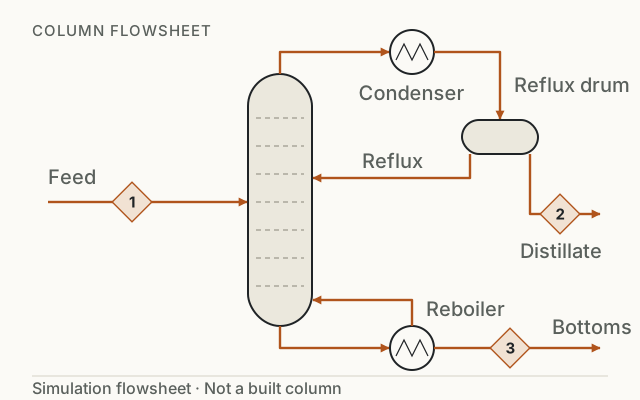
A design-project column that concentrates a dilute fermentation stream ahead of a dehydration step.
Aspen Plus
McCabe-Thiele
Excel
Design basis
The group brief fixed the feed composition and the purity the downstream dehydration step could accept. The column had to meet that purity without an unreasonable reboiler duty.
Objective
Set the design basis, choose a feed stage and reflux ratio, and show how sensitive the duty was to both.
My contribution
I built the column simulation, checked the stage count against a hand McCabe-Thiele construction and ran the reflux sensitivity from 2.0 to 4.0. I recorded the thermodynamic model and the tray efficiency assumption beside each result.
Result
At a reflux ratio of 2.5 the model reached the 90% distillate in 14 theoretical stages. A ratio of 3.5 needed 12 stages but about a quarter more reboiler duty, so I kept 2.5. These are simulation predictions. No column was built, and the real tray count depends on an assumed tray efficiency.
2
Packed column absorption study
My role
Experiment plan and analysis
Timeline
Laboratory module
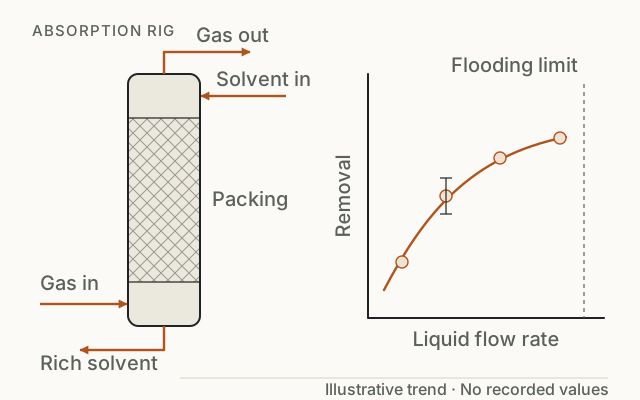
A laboratory study of how liquid flow rate changes carbon dioxide removal in a small packed column.
Packed column rig
Gas analyser
Python
Design basis
Earlier groups had reported removal figures that could not be compared because each run used a different gas flow and settling time.
Objective
Plan a run sequence that changes one variable at a time and makes the uncertainty in each reading visible.
My contribution
I wrote the run plan, fixed the gas flow, logged a settling period before each reading and repeated the centre point. I plotted removal against liquid flow with the spread of the repeats.
Result
Removal rose from about 60% to 85% as the liquid flow doubled, then levelled off as the column approached flooding. The three centre-point repeats agreed within 4 percentage points. The analyser was calibrated once at the start, which limits how far the later readings can be trusted.
3
Storage tank HAZOP study
My role
Node lead and scribe
Timeline
Process safety coursework
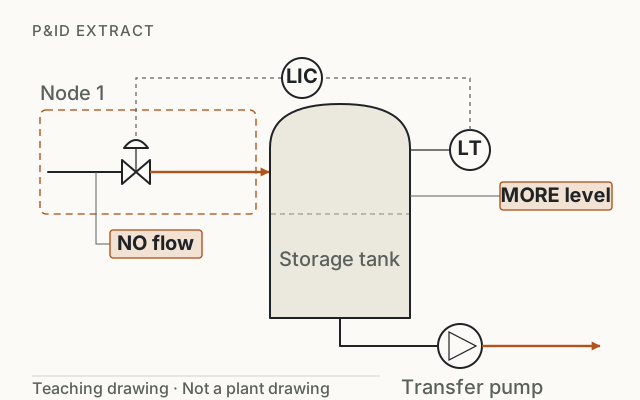
A coursework hazard study of a teaching P&ID for a solvent storage tank and its transfer pump.
P&ID review
HAZOP worksheet
Design basis
The teaching P&ID showed a level control loop on the inlet valve, but the group disagreed about what happened if that loop failed on high level.
Objective
Lead the tank inlet node, apply the guidewords in order and record each cause, consequence and safeguard.
My contribution
I led the node discussion, wrote the worksheet rows and traced every safeguard back to a tag on the drawing. Where the drawing did not show a safeguard, I recorded an action instead of assuming one.
Result
The node covered six deviations and raised four actions. The main one: the drawing shows no high-level trip that is independent of the level control loop. It is a coursework exercise on a teaching drawing, not a study of a real plant.
About
I like work where the answer depends on the assumptions. Each project here states its design basis, the decision I made and the evidence behind it, then says what a simulation or a single lab run cannot show.
Methods and tools
Process simulation
Mass and energy balances
Separation processes
P&IDs
HAZOP
Python
Laboratory methods
Technical reporting
Design reviews
Experiment planning
Experience
2024 — 2025
Laboratory demonstrator
Example University, School of Chemical Engineering
Supported second-year students on the fluid flow and heat transfer rigs.
Checked rig set-up against the method sheet before each session.
Explained how to record units and uncertainty in the lab log.
Teaching laboratory
Heat transfer
Education
2021 — 2025
MEng Chemical Engineering
Example University
Final-year design project: ethanol and water separation
Coursework in separation processes, reaction engineering and process safety